
February in Trás-os-Montes can be brutal — cold, grey, the plateau landscape stripped to its essentials. The villages in this northeastern corner of Portugal are small and spread far apart. It’s the least touristed part of the country, which is one of the reasons why what happens here at carnival has stayed close to its original form.
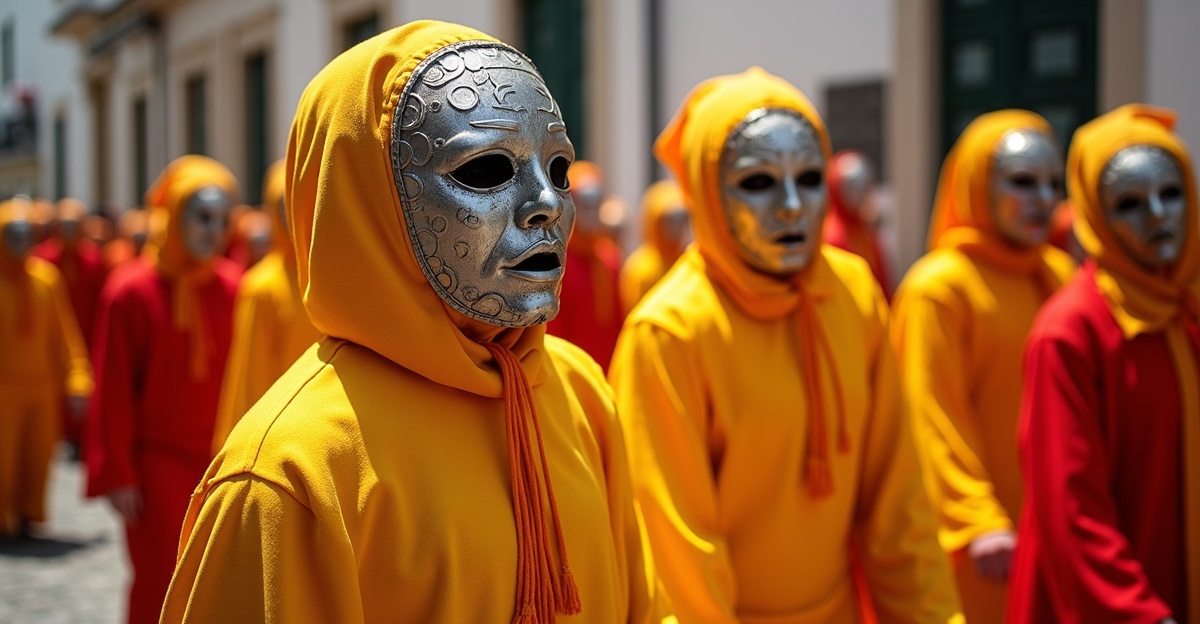
The caretos arrive on Shrove Sunday and Shrove Tuesday. They’re young men from the village — traditionally unmarried men, though the custom has evolved — wearing suits of coloured fringes and heavy brass bells on leather belts, and tin-plate or leather masks that render them unrecognisable. They run through the village, chase women, make as much noise as the bells allow, and in doing so perform something that is simultaneously a carnival, a fertility rite, and a winter-driving ceremony that predates Christianity in Iberia.
I watched it for the first time in Podence. I’d been warned it was unusual. That description didn’t quite prepare me.
BLOCK_0
What the Caretos Are
The caretos are masked figures associated with the carnival celebrations of specific villages in Trás-os-Montes, the northeastern Portuguese province. The tradition is most strongly maintained in Podence (in the Macedo de Cavaleiros municipality), Lazarim (in Lamego), and several other villages in the same broad region.
The word “careto” derives from “cara” (face) — the masked nature of the figure is central to the tradition. The masking allows the performer to act outside normal social constraints: the careto can chase, harass, and make noise in ways that would be socially unacceptable unmasked. The anonymity is functional, not decorative.
The typical careto costume consists of:
– A full-body suit of fringed fabric — coloured wool strips, rags, or fabric in patterns specific to the village
– A leather belt strung with multiple heavy brass bells (the noise is the point — the bells announce the careto’s presence throughout the village)
– A mask, either tin-plate (Podence) or carved wood (Lazarim), covering the entire face
– The whole ensemble is heavy, physically demanding to wear, and deliberately spectacular
The caretos target young women specifically — surrounding them, making noise, demanding coins or wine. The custom historically related to courtship and fertility rituals; the targeted woman’s response (or the payment to make the careto leave) was part of the social theatre. Contemporary caretos maintain the form while the specific social stakes have changed.
In 2019, the Entrudo de Podence was declared Intangible Cultural Heritage by UNESCO — recognition that the tradition was significant and at risk, and that its maintenance required deliberate cultural protection.
Podence: The Most Accessible Caretos Festival
Podence is a village of a few hundred people in the Macedo de Cavaleiros municipality of Trás-os-Montes. The Entrudo de Podence takes place on Shrove Sunday, Monday, and Tuesday, typically in February or early March (date depends on the Easter calculation each year).
The Podence festival has grown significantly since UNESCO recognition: it now attracts visitors from across Portugal and internationally, and the village organises a parallel carnival event at Macedo de Cavaleiros (the nearest town) for the Friday and Saturday before Shrove Tuesday. The core of the tradition remains at village level.
What to expect: on the main days, groups of caretos move through the village in organised parades and informal pursuits, the bells creating a constant metallic din that carries for several hundred metres. The atmosphere is festive and somewhat chaotic — there’s a specific skill to watching without becoming the target, which mainly involves not being a young woman in the careto’s path, though foreign visitors are generally treated with more gentle curiosity than local young women.
The masks at Podence are made from tin-plate (folha-de-flandres) hammered and painted. Craftspeople in the village still make them by hand; each mask is unique. The production of a full careto costume (mask, bells, suit) takes considerable time and skill and is treated as a valued craft tradition.
Lazarim: A Different Mask, the Same Tradition
Lazarim is a village near Lamego in the Viseu district, on the border between Trás-os-Montes and the Dão-Lafões region. The Lazarim caretos use hand-carved wooden masks rather than tin-plate — the technique is different, producing masks with a more sculptural quality, in some ways more directly connected to the ancient European masked carnival traditions visible across the Alps and Pyrenees.
The Lazarim festival is smaller and less internationally known than Podence’s but has strong local support and produces some of the finest mask work in Portugal. The wood-carving tradition is maintained by several village craftspeople who make masks for sale as well as for the carnival.
For visitors primarily interested in the mask as an object: Lazarim’s wooden masks are extraordinary, and several are in the collections of European ethnographic museums.
Other Careto Villages in Trás-os-Montes
The careto tradition exists, in various forms and levels of continuity, in several other Trás-os-Montes villages:
Salsas (Miranda do Douro municipality): a different variant of the northeastern carnival tradition, with distinctive costumes and a strong local identity.
Ousilhão (Vinhais municipality): another village maintaining an ancient carnival tradition in the northwestern Trás-os-Montes.
Bragança city: the regional capital holds a broader carnival event that incorporates masked traditions from across the province, useful for visitors who want to see multiple village traditions in one location.
Getting to Trás-os-Montes for the Caretos
The honest logistical answer: this requires a car and some planning. Podence is approximately 3.5 hours from Lisbon (A23 and A4 motorways), 2 hours from Porto, and 1 hour from Bragança. There’s no practical public transport to Podence village; the nearest accessible town with accommodation is Macedo de Cavaleiros (10km away).
When to go: the festival dates change each year based on the Easter calendar. In 2026, Shrove Tuesday is February 17, so the festival runs approximately February 14-17. Check the Câmara Municipal de Macedo de Cavaleiros website for the specific programme each year.
Where to stay: Macedo de Cavaleiros has basic hotel and guesthouse accommodation. Bragança (the Trás-os-Montes capital, 60km northeast) has better options and is worth visiting in its own right — the castle, the medieval citadel, and the Museu Ibérico da Máscara (Iberian Mask Museum) are all excellent.
The Museu Ibérico da Máscara, Bragança
The Iberian Mask Museum in Bragança is the best place to understand the caretos and related traditions in their broader European context. The museum houses an extensive collection of masks from across the Iberian Peninsula and comparable masks from other European carnival and festival traditions, with strong documentation of the Trás-os-Montes masked festivals.
For visitors coming specifically for the caretos festival, a visit to this museum before or after the carnival events gives valuable context. The museum is in the historic centre of Bragança, adjacent to the castle.
BLOCK_1
Frequently Asked Questions About the Caretos of Northern Portugal
What are the caretos of Portugal?
The caretos are masked figures associated with the carnival tradition of Trás-os-Montes, northeastern Portugal. They appear at Shrove-tide (the days before Lent) in specific villages, most notably Podence and Lazarim. Wearing fringed costumes, heavy brass bell belts, and handmade tin-plate or wooden masks, they run through the village making noise and targeting young women — a tradition with pre-Christian roots related to fertility rituals and winter-driving ceremonies. The Entrudo de Podence was declared UNESCO Intangible Cultural Heritage in 2019.
When and where can I see the caretos festival?
The main caretos festivals take place on Shrove Sunday, Monday, and Tuesday — the days immediately before Ash Wednesday. The dates change each year depending on when Easter falls, but typically fall in February or early March. The most accessible festival is the Entrudo de Podence in Podence village (Macedo de Cavaleiros municipality, Trás-os-Montes). Lazarim (near Lamego) holds its own festival on the same dates. Bragança hosts a broader Trás-os-Montes carnival with multiple village traditions represented.
Do I need a car to visit the caretos festival?
Yes, in practice. Podence village has no public transport connection; the nearest town with accommodation is Macedo de Cavaleiros (10km). The surrounding Trás-os-Montes region is not served by rail and has limited bus connections. Driving from Porto takes approximately 2 hours; from Lisbon, approximately 3.5 hours. Staying in Macedo de Cavaleiros or Bragança (60km) makes the festival accessible with day drives to the villages.
Are the caretos masks handmade?
Yes. The Podence caretos use tin-plate masks (folha-de-flandres) hammered, shaped, and painted by hand; no two are identical. The Lazarim caretos use hand-carved wooden masks, a more labour-intensive technique that produces sculptural objects of significant quality. The masks are considered craft objects in their own right and can be purchased directly from craftspeople in both villages. Some Lazarim wooden masks have entered ethnographic museum collections. The costume — mask, bell belt, fringed suit — represents considerable skill and time to produce.
Is the caretos festival only for the locals or can visitors attend?
Visitors are welcome. The festival has always been public by nature — the caretos perform in the streets and village squares. The UNESCO recognition and the accompanying cultural tourism development have made the Podence festival more visitor-accessible, with clearer information, viewing areas, and a programme for the broader Macedo de Cavaleiros carnival week. The atmosphere is inclusive; the caretos will engage with foreign visitors, usually with more gentle curiosity than the energetic pursuit reserved for local young women.
BLOCK_2
BLOCK_3
BLOCK_4