
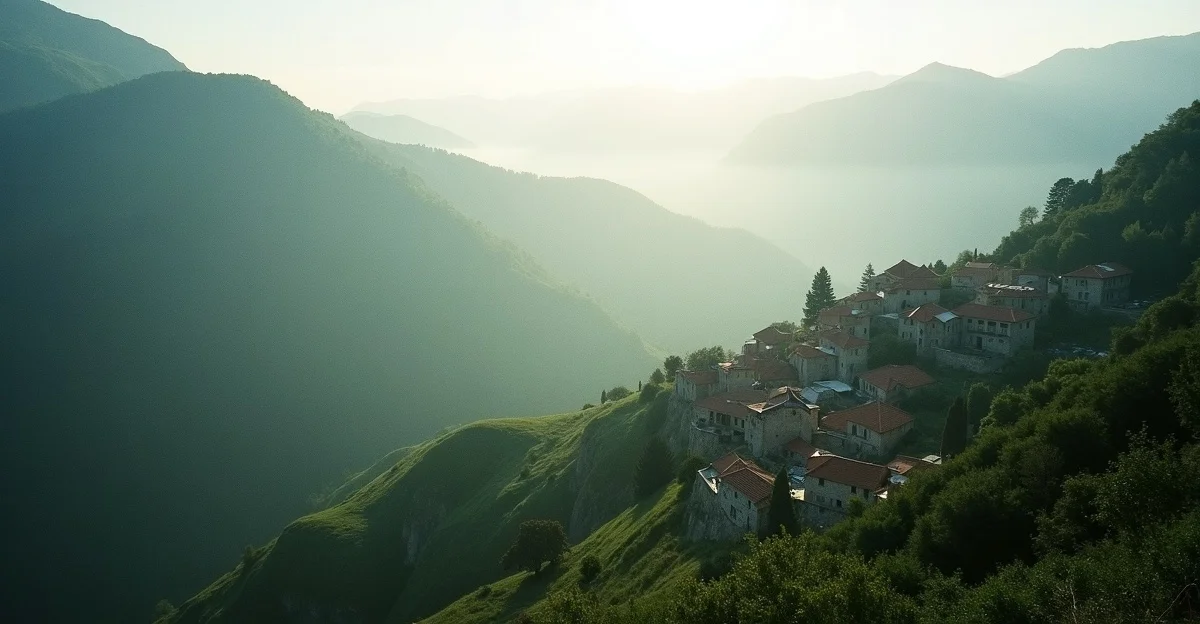
The first time I drove into Peneda-Gerês, I had to stop the car and get out. Not because of traffic — the road into the park is reliably empty in October — and not because I was lost, though my GPS had been surrendering progressively since I left Braga. I stopped because there was a horse standing in the middle of the road. A small, compact, grey-brown horse with a dark stripe along its spine, looking at me with an expression of complete indifference — as if a car with its engine idling were a mildly interesting interruption to the grass it had been eating on the verge. I turned off the engine. The horse considered me for exactly as long as it felt like, then went back to the grass.
That was eight years ago. Those Garrano ponies — an ancient, semi-wild breed that has roamed these mountains for thousands of years — still stop me every time. They are one of the things nobody prepares you for when you read about Gerês. The other things nobody prepares you for: the Roman road you can walk on, still paved with original stones laid almost two thousand years ago. The glacial valleys that look nothing like any other part of Portugal. The villages where the collective granite granaries outnumber the permanent residents. The fact that, if you sleep in the right place and conditions are right, you might hear wolves calling at night.
Peneda-Gerês is Portugal’s only national park. It covers around 70,000 hectares across the northwestern Minho mountains, along the border with Spanish Galicia. It was established in 1971 — more than fifty years ago — and remains the only area in the entire country with full national park designation. That distinction matters, because it means stricter protections, higher biodiversity, and a landscape that has been given the legal backing, at least in part, to be genuinely wild in ways that are increasingly rare in Western Europe.
I’ve been coming back to Gerês for years. I’ve hiked in November rain and September heat. I’ve slept in a converted granite farmhouse in Soajo, eaten the best trout of my life at a roadside restaurant south of Caldas do Gerês, and sat on a Roman milestone on the Geira road at sunset, trying to comprehend what two thousand years of continuous use actually means. Here’s everything worth knowing.
What Peneda-Gerês National Park Actually Is
Peneda-Gerês is Portugal’s only national park — and that simple fact deserves some unpacking, because it means something specific.
The park spans four mountain ranges in the far northwest of Portugal: Serra da Peneda, Serra do Soajo, Serra Amarela, and Serra do Gerês. It runs along the border with the Spanish region of Galicia, and together with the adjacent Parque Natural Baixa Limia-Serra do Xurés on the Spanish side, it forms a cross-border biosphere reserve. The Portuguese portion alone is home to over 800 plant species, including endemics found nowhere else on earth. There are Iberian wolves here — a subspecies (Canis lupus signatus) that has persisted in the northwestern Iberian Peninsula through centuries of persecution and habitat loss. There are golden eagles, otters, roe deer, wild boar, and those Garrano ponies. The rivers run clear and cold and full of trout.
According to the Instituto da Conservação da Natureza e das Florestas{target=”_blank” rel=”noopener noreferrer”} (ICNF), Portugal’s official nature conservation authority, Peneda-Gerês protects one of the most biodiverse areas in the entire Iberian Peninsula. The park’s conservation status distinguishes it from the country’s many natural parks and protected areas — there is nothing else quite like it in Portugal.
There are also, importantly, people. Around 15,000 people live within the park boundaries in small mountain communities, farming and keeping livestock in ways that have not changed dramatically in centuries. This is not a “pristine wilderness” national park in the North American sense, where human settlement was displaced to create the park. Gerês is a cultural landscape — mountain communities have shaped this terrain for millennia, and their presence, their granaries, their terraced fields and stone walls, are part of what makes it extraordinary.
The Landscape — What Gerês Actually Looks Like
People who haven’t been to Gerês sometimes imagine it as a greener, hillier version of the Alentejo — golden light, rolling terrain, cork oaks. It is nothing of the sort.
The landscape here is rough, steep, heavily forested in parts, and open Atlantic-swept moorland in others. The mountains are granite — the same ancient bedrock that runs through all of northern Portugal and up into Galicia — and they have a physical presence that is almost aggressive. You feel genuinely small in Gerês in a way that is rare in Portugal. The valleys are deep. The ridgelines are sharp. In winter, the peaks get snow and the higher trails become inaccessible without proper equipment.
The highest point in the park is the Nevosa, at 1,548 metres — modest by Alpine standards, but serious enough that conditions on the upper terrain can deteriorate quickly and unexpectedly. Always check weather before heading into the higher areas.
What makes the landscape remarkable is the variety compressed into a relatively small area. The Lima Valley is lush and heavily forested, with the Lindoso reservoir reflecting the mountains on clear mornings. The Soajo plateau is drier and more austere — wind-battered moorland that feels closer to the Highlands of Scotland than to anything conventionally Portuguese. The Gerês valley itself, where the old spa town of Caldas do Gerês sits, is sheltered and green, with the Rio Homem running through it. And the Peneda sector in the north — the least-visited quadrant of the park — has a wildness that I can only describe as remote in the truest sense. I’ve spent entire mornings there without seeing another person.
The Wild Horses of Gerês — The Garrano
The Garrano deserves its own section, because I’d rather you know about them before you arrive than discover them as an afterthought.
The Garrano is one of the oldest horse breeds in the Iberian Peninsula. Cave paintings in northern Portugal depict horses resembling the Garrano that may date back over 20,000 years — genetic studies suggest the breed has been largely isolated in this mountain landscape for most of that time, developing the compact build, exceptional hardiness, and distinctive coloring (bay to dark grey, always with a dark dorsal stripe) that distinguish it today. They are small — typically under 135 centimetres at the shoulder — and built for rough terrain and the variable, wet Atlantic climate of the Minho highlands.
In Gerês, a population of Garrano ponies lives semi-wild. They are not individually owned in the conventional sense — they roam freely across the mountain grasslands, no one comes to call them in at night, and they are not accustomed to human contact. You should not approach them closely and should not try to feed them. But they are visible, often near the roads on the upper sections of the park, and they have a quality of appearing at exactly the moment you need to be reminded that this is a place where genuinely wild things still happen.
The Garrano is classified as an endangered breed. The Associação de Criadores do Cavalo de Raça Garrana{target=”_blank” rel=”noopener noreferrer”} maintains the studbook and works to protect the remaining population. The Gerês herd is among the most important for the breed’s long-term survival.
Best Hikes in Gerês — Where to Actually Go
The park has over 80 marked trails. I’m going to tell you honestly about the ones I’ve actually done — not a list compiled from tourist office brochures.
PR1 Geira — Walk a Roman Road Built in the 1st Century AD
This is my favourite hike in the park and, I would argue, one of the most remarkable walks in all of Portugal. The trail follows a section of the Via Nova — sometimes called the Geira — a Roman military road built in the 1st and 2nd centuries AD to connect Bracara Augusta (the Roman capital of what is now the Minho, modern-day Braga) with Asturica Augusta (Astorga, in Spain). The road is almost two thousand years old. Large sections of the original paving — granite slabs laid by Roman legionaries — are still intact and still walkable.
The PR1 trail follows the Geira for approximately 14 kilometres between the villages of Mata do Bouro and Campo do Gerês. It’s rated moderate (some elevation, some rough terrain) and takes most walkers between four and six hours depending on pace and how long they spend staring at the milestones. There are over 75 Roman milestones (miliários) along the Geira route within the park, most still in their original positions, inscribed with the names of emperors.
I have done this trail three times. Each time I find a milestone I missed before. The whole experience has a slightly surreal quality — the awareness that you are walking on a road that was already four hundred years old when the Portuguese nation was founded.
Trilho das Pedras Parideiras — The Birthing Stones
Near the village of Pitões das Júnias, this shorter trail (around 5km return) leads to a geological phenomenon that sounds invented but is very real: granite boulders that appear to “give birth” to smaller spherical granite balls, which push gradually through the surface of the host rock over thousands of years. The process is spheroidal weathering — differential erosion along fracture planes — but the local name, “pedras parideiras” (literally “birthing stones”), is considerably more poetic and accurate to what you see.
The trail also passes through beautiful highland moorland and takes you near the ruins of the Mosteiro de Santa Maria das Júnias — a Benedictine monastery founded in the 12th century, now roofless and slowly returning to the hillside, but hauntingly atmospheric with its Romanesque stonework still largely intact.
The Waterfall Trails — Cascata do Arado and Beyond
The park has several excellent waterfall walks, mostly concentrated in the Gerês valley sector. The Cascata do Arado is the most visited — a two-tiered waterfall in a granite gorge, accessible via a straightforward walk of roughly 2km each way from the nearest parking area. The pool at the base is cold (properly cold, regardless of air temperature), clear, and swimmable in summer. On peak summer weekends it gets crowded; arrive before 9am or come in shoulder season.
Less visited and equally worth the effort: the Cascata da Fecha de Barjas, which requires a longer approach hike but rewards you with a more isolated setting and a more dramatic fall. I have been there on an October weekday with the place entirely to myself, which is exactly the kind of experience you come to Gerês for.
Swimming in the Park — The Best Spots
Swimming is one of the main reasons people visit Gerês in summer, and the quality is genuinely exceptional. The park’s rivers and reservoirs are clean, cold, and in many places simply beautiful in ways that are hard to photograph accurately.
The Praia Fluvial de Lindoso on the Lima River near the Lindoso reservoir is the most reliable choice — it has facilities (toilets, a lifeguard in season, some shade) and a beautiful setting at the reservoir’s edge. The Praia Fluvial de Ermal and the swimming spots along the Rio Homem near Caldas do Gerês are also popular. My personal preference for avoiding crowds: ask at your accommodation for the local swimming holes that don’t appear in any guide. Every village in Gerês has at least one, and they will tell you if you ask directly.
The Villages of Gerês — Where Culture Meets Landscape
Soajo and Its Extraordinary Espigueiros
Soajo is a small village on the exposed plateau above the Lima Valley, and its main attraction is one of the strangest and most photogenic architectural ensembles in Portugal: a cluster of around 24 espigueiros (raised granite granaries) gathered together on a rocky outcrop at the edge of the village. These structures — elongated, elevated on stone legs (palheiras) designed to prevent rodents from climbing in, with slatted sides for ventilation — were used to dry and store maize after harvest. They look, from a distance, like a gathering of small ships or a miniature stone city. Up close, they are intricately built and obviously functional.
The espigueiros of Soajo are still occasionally used, though maize cultivation here is much reduced. The village also has a working communal oven (forno comunitário) where bread is still baked collectively, a beautiful old church, and the unhurried pace of a place that has not been organised around tourism.
Neighbouring Lindoso has its own espigueiro collection — arguably more dramatic, because they sit immediately below a 13th-century castle (the Castelo de Lindoso) with views across the Lima River toward Spain. The castle itself is one of the best-preserved medieval fortifications in northern Portugal. It is free to enter. I’d rank Lindoso’s viewpoint as one of the best in the entire Minho region — the combination of the espigueiros, the reservoir, the Spanish border hills, and the castle walls in one sightline is something I come back to regularly. If you’re building a Portugal castles itinerary for northern Portugal, this one should be on the list.
Pitões das Júnias — The Village at the Edge of Everything
Pitões das Júnias is one of the highest and most remote communities in the park — it sits at around 1,000 metres, surrounded by open moorland that feels like the Atlantic edge of the world. The village is small, granite-built, with the characteristic stone houses of the Minho highlands that seem to have grown directly from the bedrock rather than been built on it.
The ruined monastery at Júnias (Mosteiro de Santa Maria das Júnias) is about 2km from the village along a good path, and it is worth the walk. A Romanesque church facade, partial cloister walls, an apse that catches the light in late afternoon — all of it beside a small river, in a landscape of heather and granite boulders. I’ve spent an hour here in complete silence and considered it among the better hours I’ve spent in northern Portugal.
Caldas do Gerês — The Old Spa Town
Caldas do Gerês is the main tourist hub of the park, and it is unlike anywhere else in Portugal. It is a 19th-century thermal spa town, built around mineral springs used since at least the Roman period, and it has all the faded grandeur of such places: colonnaded promenades, old spa pavilions, large hotels with the slightly melancholy atmosphere of somewhere that was once fashionable and knows it, elderly visitors on walking frames taking the waters between meals.
I say “faded grandeur” with genuine affection. Caldas do Gerês is odd, a little melancholy, and extremely characterful — it exists in its own temporal register, unbothered by the present. The main promenade is pedestrianised, lined with cafés and souvenir shops selling heather honey, juniper liqueur, and embroidered linens. The thermal spa water (ferruginous, slightly sulphurous, historically prescribed for liver and kidney conditions) is available from a public fountain near the main square, for free, whenever you want it.
For accommodation, Caldas do Gerês has the widest choice in the park area. But I’d suggest, if you have the option, staying in one of the converted quintas or guesthouses in the villages (Soajo, Lindoso, or the Lima Valley) for a more immersive experience. The park is very different from inside a village than from a hotel in a spa town.
Where to Stay in Gerês
The accommodation landscape in and around Peneda-Gerês has improved considerably over the past decade. The options now range from agro-tourism quintas in converted granite farmhouses to small hotels in Caldas do Gerês to official campgrounds.
My personal preference is the agro-tourism properties in the Lima Valley and around Soajo — buildings that are genuinely old, that are surrounded by the park landscape rather than adjacent to it, and whose owners are invariably a better source of local knowledge than any guidebook. They will tell you where the trout are running, which trail is flooded after heavy rain, and whether anyone has heard wolves recently in the upper valley.
Camping in Gerês is excellent. The Parque de Campismo de Cerdeira (near Campo do Gerês) is the most established and well-equipped official campground, with good facilities and a strong community of return visitors. There are also smaller private campgrounds. Wild camping is not permitted anywhere within the park — this is enforced, and the reason is sound: the park’s ecosystem simply couldn’t absorb unregulated overnight use.
Where to Eat in Gerês
Gerês food runs on two tracks: genuine mountain food in village restaurants, and “tourist menu” fare in Caldas do Gerês and the more visited trailhead areas. I strongly recommend the former wherever you can find it.
Cabrito assado (slow-roasted kid goat) is the dish of this region — locally raised, cooked for hours, served with roast potatoes and a simple salad. When done well, it is one of the best things you can eat in northern Portugal. Most village restaurants that serve it do it well, because the animals are genuinely local and the method hasn’t changed in generations.
Trout (truta) from the park’s rivers is also exceptional. Grilled whole, with good olive oil and lemon. Do not overthink it. Do not order anything with a cream sauce if trout is on the menu.
Mel de urze — heather honey from Gerês — is one of Portugal’s most distinctive honeys: dark, intensely aromatic, slightly bitter, quite unlike anything commercially produced elsewhere. Buy a jar directly from a local producer or from one of the shops in Caldas do Gerês. It travels well and lasts for months. It is the kind of thing you bring home and then spend weeks failing to explain to people who ask what makes it different.
For a reliable, honest meal: A Videira, in the village of Vilar da Veiga just south of Caldas do Gerês, has been serving unfussy, locally sourced mountain food for years. The portions are substantial. The wine list is short but well-chosen. The cabrito is worth the specific detour.
When to Visit Gerês — An Honest Breakdown
Gerês is properly seasonal in a way that most of Portugal is not, and it matters significantly which time of year you come.
Spring (April–May): My preference. The waterfalls are at their most powerful from winter rainfall. The wildflowers — heather, gorse, rock roses — are spectacular. The trails are largely empty. The weather is changeable and rain is likely (the Minho is the wettest region in Portugal), but the light when it breaks is extraordinary and the park has an energy in spring that is unlike any other season.
Summer (June–August): The river beaches are at their best, conditions are reliable, and the park is fully accessible without cold-weather concerns. The downside: it is busy, particularly on summer weekends. The road through Caldas do Gerês can get genuinely congested. Book accommodation well in advance and do trails in the early morning before heat and crowds arrive.
Autumn (September–October): My second preference, very close behind spring. The light is exceptional — angled and golden in a way that transforms the granite landscape. The heather is turning. Visitor numbers drop significantly after mid-September. Wildlife feels more active as temperatures drop, and the Garrano ponies seem particularly visible in autumn; my best sightings have been in October.
Winter (November–March): Cold, frequently wet, occasionally snowy on the high ground. Most accommodation in the smaller villages closes. But if you are an experienced hiker and want the park genuinely to yourself — I mean that, genuinely to yourself — winter is the time. I went in late January one year and encountered exactly two other people in two days of hiking. The park in winter has a starkness that is its own reward, and a quietness that is hard to find anywhere in Europe anymore.
Getting to Gerês from Porto and Braga
The most practical way to reach Peneda-Gerês is by car — the park’s trails and villages are spread across a large area, and public transport connections to the interior of the park are limited.
From Porto, the drive is approximately 1.5 to 2 hours via the A3 motorway toward Braga, then the IC27 toward Gerês. Hire a car in Porto for the duration of your Gerês visit if you don’t have your own vehicle. Gerês is a natural extension of a northern Portugal itinerary that includes Porto, the Douro Valley, and the Minho.
From Braga — the closest major city, roughly 45 minutes from Caldas do Gerês — there are limited bus services to the park in summer. Braga itself is worth stopping in: a city with a baroque cathedral, a dense medieval centre, and the extraordinary Bom Jesus do Monte sanctuary above the city. If you’re combining Gerês with the Minho coast, a night in Braga on the way is a sensible plan. From there, it’s also straightforward to visit Caminha on the Spanish border — a medieval town on the Minho River that almost nobody visits and that pairs perfectly with a Gerês trip.
For visitors coming from Lisbon: the drive is approximately four hours, or a two-hour train to Porto followed by the drive above. Most visitors from the south combine Gerês with Porto and the Douro, spending three to five days in the north. That is a reasonable minimum for doing it properly; a full week is better.
Practical Information for Visiting Gerês
Entry fee: There is no entry fee to visit Peneda-Gerês National Park. You do not need to register, book a slot, or pay a gate admission. Some specific facilities (official campgrounds, certain visitor centres) have their own charges, but access to the park itself is free.
Maps and navigation: The ICNF publishes official trail maps, available at the park’s visitor centres (the main one is in Braga; there are information points in Caldas do Gerês and at some trailheads). Downloading offline maps before you go is strongly advisable — mobile signal is patchy to non-existent in many parts of the park. I use OsmAnd with the downloaded northern Portugal map. This is not optional if you plan to hike independently.
Wildlife: The Iberian wolf population in Gerês is estimated at a few dozen individuals in the park area, and they are extremely shy — sightings are genuinely rare, even for rangers who work in the park daily. Do not expect to see one. If you’re hiking in the Peneda sector or upper Gerês highlands, make noise on the trail, keep dogs on leads, and don’t approach livestock protection structures (stone enclosures with distinctive overhanging roofs, called bácoros, designed specifically to exclude wolves). The wolves present no danger to humans with standard trail awareness.
Fire risk: The Minho mountains have experienced severe wildfires in recent years, in common with much of rural northern Portugal. In summer months, fire risk can be extreme. Do not light fires, barbecues, candles, or cigarettes anywhere outside designated areas with facilities. Check regional fire risk bulletins before hiking in July and August.
Water: The rivers and streams in Gerês are generally clean and fast-flowing, but I’d recommend carrying enough water for any trail rather than relying on finding potable sources en route.
The Gerês and Portugal Countryside Connection
Gerês represents something distinct in Portuguese geography — the rural north at its most elemental. If your interest in Portugal extends beyond cities and resorts, it fits naturally into the kind of trip explored in our Portugal countryside guide, which covers the other rural regions worth knowing: the Alentejo plains, the Douro Valley terraces, Trás-os-Montes in the far northeast. Each is different. Gerês is the wild one.
Frequently Asked Questions About Gerês Portugal
Is Peneda-Gerês the only national park in Portugal?
Yes. Peneda-Gerês, established in 1971, is Portugal’s only national park. The country has numerous natural parks and protected areas, but only Gerês carries full national park designation — meaning the highest level of legal protection and the strictest development controls. This makes it uniquely significant in terms of biodiversity and landscape preservation.
Can you see wolves in Gerês?
Iberian wolves (Canis lupus signatus) live in Peneda-Gerês, but seeing one is genuinely rare. The population within the park is estimated at a few dozen individuals; they are nocturnal, very shy, and actively avoid human contact. The most likely “evidence” of wolves for most visitors is the characteristic stone livestock enclosures (bácoros) designed to exclude them, or tracks in mud near water on a quiet early morning. Hearing them at night — a low, carrying howl — is more likely than a sighting, but still not common.
When is the best time to visit Gerês?
Spring (April–May) and autumn (September–October) offer the best combination of good conditions, active wildlife, accessible trails, and manageable visitor numbers. Summer is peak season for river swimming and weather reliability, but brings significantly more crowds. Winter is largely empty but requires experience and appropriate gear for the upper trails.
Do I need a 4×4 to visit Gerês?
No — for the main visitor areas. The roads to Caldas do Gerês, Soajo, Lindoso, and most established trailheads are accessible by standard passenger car. Some very minor tracks in remote areas (particularly parts of the Peneda sector) benefit from higher ground clearance, but these are beyond normal visitor itineraries. Plan with a normal car and you will be fine for everything described in this guide.
Are dogs allowed in Peneda-Gerês?
Dogs are permitted in most areas of the park but must be kept on a lead at all times. This rule is particularly important in areas where livestock graze and where wolves may be present — a loose dog in a sheep pasture is a problem for everyone. If camping, confirm your chosen campground’s dog policy in advance.
What is the Garrano horse in Gerês?
The Garrano is one of the oldest horse breeds in Iberia, a small, compact, hardy mountain pony that has lived semi-wild in Peneda-Gerês for millennia. You can recognise them by their compact build, bay or grey coloring, and dark dorsal stripe. They roam freely and are not accustomed to human contact — observe them from a distance and do not attempt to feed or approach them. Seeing a Garrano on the mountain road is one of Gerês’s most distinctive experiences and one that no photograph really captures adequately.
The Honest Conclusion
Gerês recalibrates what you think Portugal is. If you’ve come from Lisbon or the Algarve — from whitewashed walls and terracotta rooftops, from the light-flooded south — the granite highlands of the Minho feel like a different country. Greener, rougher, older, more austere. The light is different. The food is different. The pace is different. The silence, in the right parts of the park at the right time of year, is the silence of somewhere that has not been arranged for visitors.
That is not a criticism of anywhere else. It’s a description of why Gerês deserves to be on your itinerary even if — especially if — you think you already know Portugal.
The Garrano ponies will ignore you. The wolves won’t show themselves. The Roman road will make you feel simultaneously ancient and entirely temporary. And you will, almost certainly, stay longer than you planned.